


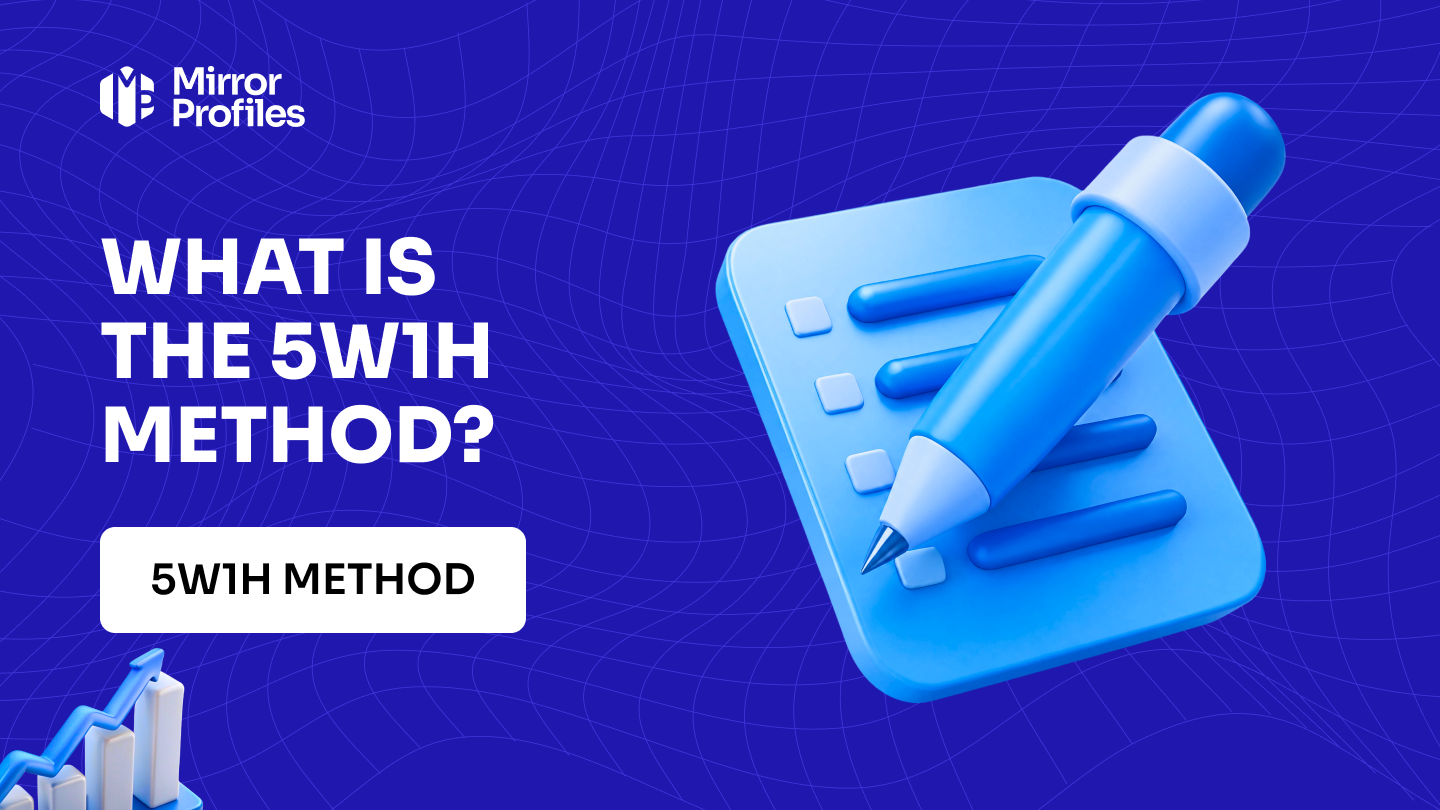
The 5W1H method, also known in French as the QQOQCP method, is an essential tool for collecting and analyzing information in order to understand and identify problems. It rests on six fundamental questions: Who? What? Where? When? How? and Why? These key questions help pinpoint the circumstances of a situation precisely, and prove useful in many fields such as customer relations, recruitment and sales prospecting.
Used to solve problems, make informed decisions and improve communication, the 5W1H method encourages you to ask the right questions to get complete, factual answers and a thorough understanding of any situation. It is a perfect method to use in prospecting or recruiting through LinkedIn automation. Combined with several dedicated LinkedIn accounts rented from MirrorProfiles, which multiply your prospecting volume, it proves very effective.
This article explores how to apply the method effectively, and discusses its benefits and limits in a range of practical contexts.
Origins and definition of the 5W1H method
History and origin
The 5W1H method has its roots in Antiquity, going back to the 1st century AD. Yes, we are going to draw a parallel between Antiquity and LinkedIn: that’s the MirrorProfiles team’s writing style for you.
It is credited to Marcus Fabius Quintilianus, an eminent Roman rhetorician. Quintilianus developed an exhaustive questioning technique to grasp a situation in its entirety. This technique, initially known as “Quintilian questioning”, evolved over time. It was notably adopted by scholastic thinkers in the Middle Ages, who formalized it in Latin as “Quis, Quid, Ubi, Quibus auxiliis, Cur, Quomodo, Quando”.
Simple definition
The 5W1H method is a contextual analysis tool built around six key questions for collecting and examining information exhaustively. The acronym stands for Who? What? Where? When? Why? and How? The method sometimes includes an additional question, How much?, which gives the 5W2H variant. This variant enriches the analysis by quantifying the elements of a situation, an action, a communication or a project, allowing for a more precise, structured understanding and definition.
The components of the 5W1H method
The 5W1H method is structured around six key questions, with an optional seventh: “How much?”. These questions make it easier to collect structured information for a better understanding and analysis of situations.
Who?
This question identifies the individuals or groups involved. It covers the main actors, the stakeholders, and those affected or responsible within the problem or project. In prospecting, for example, it lets you determine the end customer, the team members and the people in charge of the different tasks. Very useful for building quality prospecting lists.
What?
“What?” defines the problem or the objective, clarifying what is at stake and the potential consequences. In the case of an industrial machine breaking down, it would describe the specific problem and its impact. For your future customers, it is their need or their challenge.
When?
This question places the event in time, specifying how long the problem has lasted, the key moments when it appears and the important deadlines. It can include precise dates, frequencies or specific timeframes.
Where?
“Where?” locates the situation, whether it is the place where the project is carried out, the location of the problem or the location of the resources needed. In sales, for example, it could specify the delivery location or the target market. In prospecting, we would rather talk about acquisition channels, in this case LinkedIn.
How?
The “How?” question explores the processes and approaches used to tackle a problem. It guides us in understanding the participants’ actions, how the problem manifests itself and the strategies for reaching the targeted objectives. It covers the procedures to follow, the essential resources and the specific skills required. This is where your MirrorProfiles LinkedIn accounts come in: they are what you will use to contact your prospects.
Why?
Asking “Why?” reveals the motivations and reasons behind a given situation. This question sheds light on the importance and value of a project or problem, providing a basis for justifying the proposed measures. It covers the underlying motivations, the strategic objectives and the expected benefits. The “Why” is what makes your prospecting messages strong: your LinkedIn copywriting must be short and effective to quickly answer your prospects’ “Why”. Why would they take the time to learn about your solution?
How much? (if applicable)
Adding the question “How much?” lets you gather essential quantitative data. It helps clarify financial aspects such as the budget, deadlines, required resources and potential economic impact. In project management, for example, this can concern the available budget, the number of participants or the time needed to complete a task.
Practical applications of the 5W1H method
The 5W1H method is remarkably versatile, adapting to a variety of contexts to improve the efficiency and transparency of processes. Let’s look at a few areas where it proves particularly useful.
In project management
In project management, the 5W1H method is used to define the project clearly and to address specific problems. It plays an essential role in communicating precise information to key stakeholders, such as senior management or clients, making mutual understanding easier. It is all the more relevant during pre-planning meetings or periodic reviews, where it helps prevent misunderstandings.
In LinkedIn prospecting with your MirrorProfiles accounts
When it comes to sales prospecting, particularly on platforms such as LinkedIn, the 5W1H method proves to be a valuable tool. By using its structured questions, sales reps can get a complete picture of prospects’ needs and expectations. This supports a personalized approach and tailored suggestions, significantly increasing the chances of success in prospecting conversations.
For process analysis
Process analysis benefits greatly from the 5W1H method. By methodically asking the associated questions, it becomes possible to break a complex process down into its basic components, making it easier to understand the interactions between each step. This approach is essential for identifying inefficiencies, bottlenecks and opportunities for improvement.
In problem-solving
Problem-solving is arguably one of the most frequent applications of the 5W1H method. By systematically questioning along the 5W1H axes, it is possible to trace a problem back to its origin and determine its underlying causes. This strategy ensures that solutions are based on a thorough analysis of the situation, and proves particularly effective for problems of low to moderate complexity.
Benefits and limits of the method
The benefits
The 5W1H method is recognized for its many benefits, which make it an extremely useful tool in a variety of contexts, both professional and personal.
Simplicity and versatility: Easy to understand and apply, the 5W1H method is accessible to everyone, with no specific training required. It is useful in many sectors, including project management, sales, process analysis and problem-solving, demonstrating its great adaptability.
Exhaustiveness: By asking the key questions (who, what, where, when, how and why), the 5W1H method gives a complete understanding of the situation, making it possible to identify the essential elements and design suitable solutions.
Easier communication: It simplifies information sharing and prevents misunderstandings, which is particularly useful during meetings and interactions with stakeholders.
Better sales technique: Salespeople can rely on the 5W1H method to gather detailed information on customers’ needs, supporting personalized approaches and increasing sales opportunities.
The limits and criticisms
Despite its strengths, the 5W1H method has limits and has drawn criticism.
Analysis time: It takes time to formulate and analyze the questions, which can be a disadvantage in contexts where time is a constraint.
Risk of misinterpretation: Since it relies on human input, there is a risk of misinterpreting the answers. The method cannot be automated and requires careful attention when formulating the questions.
Rigidity: Based on a set of general questions, it may not capture the nuances or complexity of certain situations. This rigidity can limit its ability to adapt to particularly specific or detailed cases.
Tips for implementing the 5W1H method effectively
To get the most out of the 5W1H method, it is essential to follow a few key steps. Here are some tips for a successful application.
Preparation
Good preparation is indispensable before getting started with the 5W1H method. Here are the preliminary steps:
Training and awareness: It is important that the whole team understands the method and why it matters. Organize training sessions or meetings to present the principles and benefits of the 5W1H method.
Defining objectives: Clearly identify the goals and scope of the project or situation to analyze. This will help you ask targeted questions and get useful answers.
Question script: Build a script of questions based on the 5W1H method to make sure you cover all the essential aspects. This will structure your analysis methodically.
Putting it into practice
For effective implementation, follow these guidelines:
Collecting information: Use the 5W1H questions to gather information on the people involved, the actions, the environment, the timing, the methods, the quantitative aspects and the underlying reasons for the processes under way.
Analyzing the data: Spot inefficiencies and opportunities for improvement by examining the data collected. Prioritize the key elements to identify the major problems.
Formulating solutions: Use brainstorming to generate solutions based on your analysis. Choose the most suitable ones and adapt them to your particular context.
Evaluation and follow-up
Once the solutions have been implemented, it is vital to monitor their progress and evaluate their effectiveness:
Implementation and monitoring: Develop a detailed action plan for the chosen strategies and track their progress using key performance indicators. This will help you assess the effectiveness of the measures taken.
Evaluation and adjustment: Analyze the impact of the strategies and adjust your plans based on results and feedback. This will encourage continuous improvement of processes and solutions.
Clear communication: Make sure communication stays clear and transparent at every level of the organization. This will secure employee buy-in and foster a culture of continuous learning.
In conclusion, the 5W1H method proves to be a powerful, versatile tool, essential for structuring and analyzing situations comprehensively. By focusing on the essential questions “Who? What? Where? When? How? and Why?”, this approach gives you a global, in-depth understanding of any project or problem. Its usefulness extends to fields such as project management, sales and problem-solving, improving communication, clarifying what is at stake and helping to build tailored strategies.
It encourages careful preparation of the questions, systematic collection and analysis of information, and rigorous follow-up of the results to maximize the benefits. Integrating the 5W1H method into your processes is a step towards greater efficiency. Build it into your sales or recruitment processes and you will quickly see the difference.