


Introduction
Companies face a constant challenge: maintaining a meaningful and effective connection with their customers. This need stems from the ever-changing expectations of consumers, who now look for more personalized, faster and more engaging interactions with brands. In response, Social CRM has emerged as a strategic way to bring the dynamics of social networks into customer relationship management. So what is Social CRM, exactly, and why should you consider it? Here is a clear definition, its main benefits and the kind of tool to pair it with for prospecting.
What is a Social CRM?
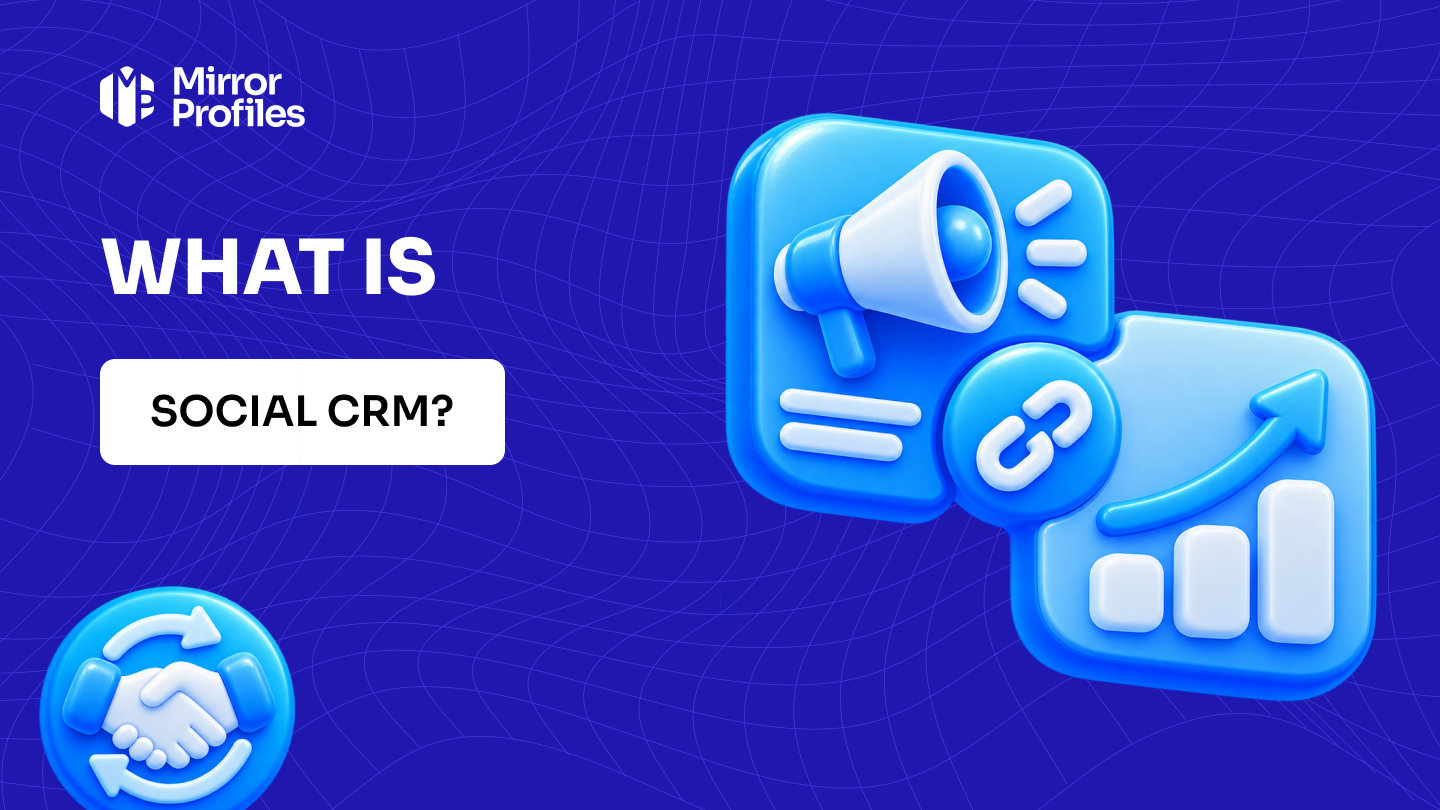
Social CRM represents a strategic evolution of traditional CRM (Customer Relationship Management).
A Social CRM differs from a traditional CRM mainly in its ability to integrate interactions on social networks directly into customer relationship management. While a traditional CRM focuses on managing customer data from direct contact channels such as phone calls, emails and face-to-face meetings, Social CRM enriches this database with insights from Facebook, Twitter, LinkedIn and other social platforms.
This integration not only enables a more complete understanding of consumer behavior by capturing their public interactions and shares on networks, but also facilitates more personalized and engaging communication. For example, a Social CRM makes it possible to respond quickly to comments or mentions of the brand, offering real-time interaction that can significantly improve the customer experience and strengthen loyalty. In short, while traditional CRM offers an overview of customer interaction history, Social CRM extends this view to include the social context, which is essential for companies seeking to make the most of modern communication and marketing dynamics.
Social CRM also facilitates internal collaboration. Information gathered via social networks can easily be shared between different departments, such as marketing, sales and customer service, thanks to the CRM. This enables a consistent and informed response to customer requests or comments, improving operational efficiency and customer satisfaction.
This makes Social CRM a powerful tool for companies seeking to strengthen their customer relationships in an increasingly data-driven world. Social CRM enables in-depth consumer understanding and personalized interaction on a large scale, both essential for building long-lasting, mutually beneficial customer relationships.
Why choose Social CRM?
Opting for Social CRM offers a host of significant advantages for any company wishing to modernize its customer relationship management and maximize its impact on social networks. Here are some key benefits of integrating a Social CRM:
- Empower your support team: with a Social CRM, customer service representatives have access to rich, detailed information from social interactions. This enables them to quickly understand customers’ problems and propose effective, customized solutions. This rapid response capability significantly improves customer satisfaction and optimizes service performance.
- Understand your audience: integrating real-time data into a Social CRM provides an in-depth understanding of your target audience’s preferences and behaviors. This valuable information can be used to fine-tune marketing and communication strategies, to deliver a tailored and consistent customer experience.
- Publish relevant content: the insights gained from Social CRM help you identify users’ interests and needs on social networks. This makes it easier to produce and distribute highly relevant, engaging content across the most appropriate channels, increasing customer engagement and loyalty.
- Set your interactions in a social context: using data collected via social networks enriches your interactions with prospects and customers. This humanizes your brand by contextualizing conversations, building trust and establishing deeper, more meaningful relationships.
- Instant feedback: Social CRM alerts you immediately to feedback, whether positive or negative. This responsiveness means you can quickly adjust your products and services in line with customer expectations and reactions, creating a dynamic of continuous improvement based on real feedback.
In short, choosing a Social CRM transforms the way a company interacts with its customers and makes the most of social networks, turning every interaction into an opportunity to strengthen customer relationships and optimize sales and marketing strategies.
The pre-CRM, the tool to pair with your Social CRM
A pre-CRM enriches and complements your Social CRM, with a focus on sales prospecting, a crucial but often complex aspect. Companies that prospect on LinkedIn need a place to manage their sales actions: automation and LinkedIn prospecting have become essential for B2B companies, but they generate a lot of data. If you want to make the most of this wealth of prospect data, you need to be able to organize and analyze it properly. A pre-CRM is therefore a complementary tool for all your sales initiatives.
The tool synchronizes with the prospecting tools already in use in your company, making it easy to centralize data from a variety of channels and platforms, including LinkedIn interactions. This integration not only centralizes information, but also enriches analysis and exploitation capabilities to improve sales performance.
A pre-CRM dashboard aggregates essential prospecting data, enabling sales reps to easily visualize the information that matters for their activity. By combining this data with the data collected via your Social CRM, it facilitates in-depth, targeted analysis, so that strategies can be adjusted dynamically to maximize results.
One of a pre-CRM’s key features is its ability to automatically generate task lists for sales teams. Based on aggregated data, the tool prioritizes actions and ensures that the most promising opportunities are addressed quickly. This feature speeds up sales processes and reduces reaction time to market opportunities.
A good pre-CRM offers a structured method for optimizing your sales pipeline. The aim is to convert as many prospects as possible into qualified leads, while avoiding the pitfalls of mixed marketing campaigns (outbound and inbound) that can compromise the effectiveness of prospecting actions.
What’s more, a pre-CRM saves sales staff valuable time. The tool lets them follow up all their prospects from a single interface and provides automatic reporting. These features ensure a constant flow of sales actions and avoid the time wasted by dispersed data management. In short, a pre-CRM is a well-suited tool for improving your sales velocity and the effectiveness of your Social CRM by reinforcing your prospecting strategies. Once a prospect enters the lead category, they are transferred to your classic CRM or Social CRM.
In a context where consumers expect increasingly personalized and responsive interactions, Social CRM is a key strategic solution for companies. An evolution of traditional CRM, this system enriches customer relationship management by integrating interactions on social networks, offering a more complete understanding of consumer behavior. This enables more personalized communication and real-time engagement, improving customer experience and loyalty.
Adopting a Social CRM brings several significant benefits: it gives support teams the information they need for fast, personalized responses, it enables a better understanding of audience preferences to adjust marketing strategies, and it facilitates the delivery of relevant content that increases customer engagement. What’s more, the data collected via social networks enriches interactions, humanizes the brand and strengthens customer relations.
In short, Social CRM transforms how companies interact with their customers, treating every exchange as an opportunity to strengthen relationships and optimize sales and marketing strategies.
Integrating a pre-CRM with your Social CRM system can significantly change your approach to sales prospecting. By synchronizing and intelligently using data from your social networks, it enables your teams to better target and serve your prospects and customers. This translates into greater efficiency, better time management and, ultimately, more conversions and higher customer satisfaction. Adopting a pre-CRM means choosing a tool that supports and amplifies your prospecting efforts, while enriching customer relations at every stage of the customer journey.