


Introduction
Using LinkedIn to acquire customers is a great idea! First of all, if you want to know whether your target is on LinkedIn, I suggest you read this article.
But before prospecting with your sales reps’ personal LinkedIn account, it’s important to think carefully. Using LinkedIn for prospecting has a direct impact on your company’s image.
Your sales people represent your company, and their activity on LinkedIn will reinforce this image.
So it’s crucial to consider the time and budget involved, and whether this strategy is appropriate for your sales reps’ LinkedIn profile.
What is the purpose of a LinkedIn account?
LinkedIn is a professional platform offering a multitude of features to help businesses and professionals generate new deals and develop their professional network.
Here are some of the possibilities offered by a LinkedIn account:
Your sales rep’s initial network
Your sales rep’s initial network is made up of all the connections he or she has already established on LinkedIn. This can include current and former colleagues, customers, suppliers, business partners, etc.
This initial network is valuable because it can be used as a starting point for expanding your network and reaching new prospects.
For example, your sales rep can share relevant content with their initial network, which can then be shared with their own networks, increasing your company’s visibility.
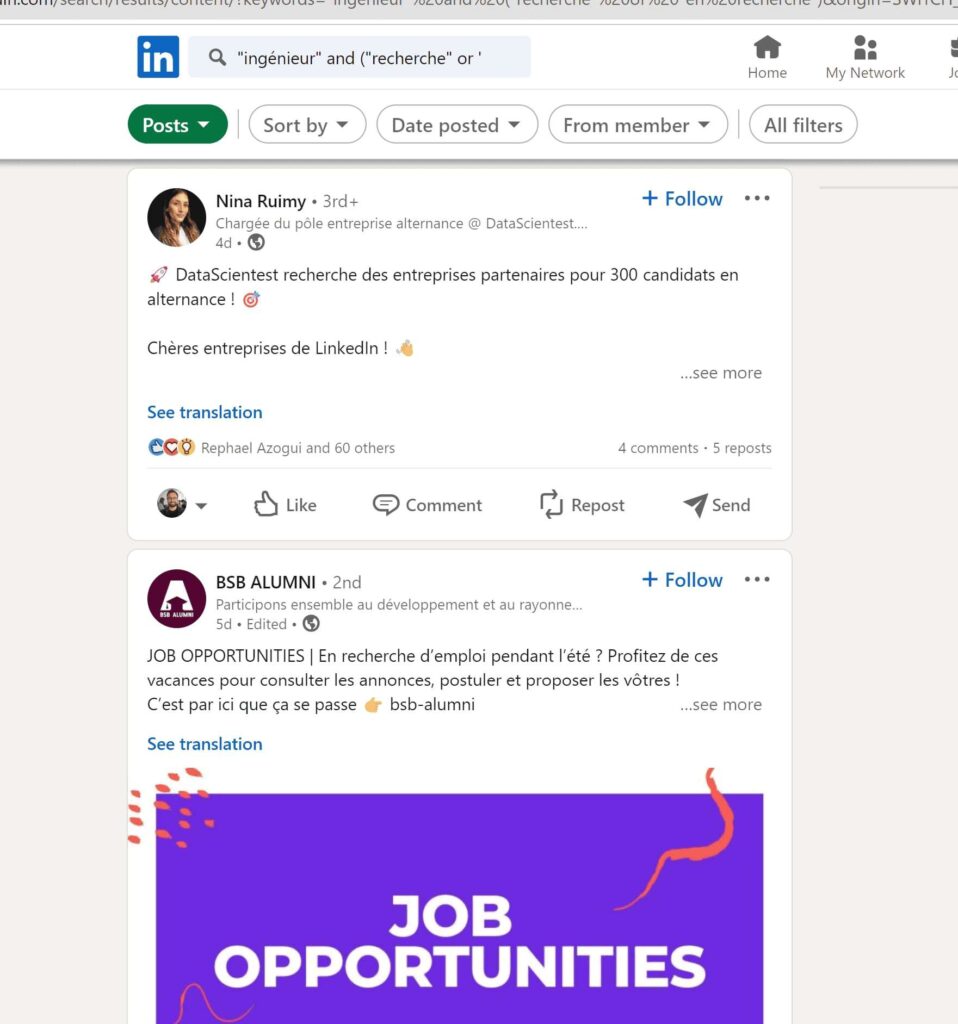
The ability to target people who have made specific LinkedIn posts
LinkedIn lets you search for people based on the content they have shared on the platform. For example, if you’re a company that sells project management software, your sales rep might look for people who have shared articles or posts about project management.
This allows you to target prospects who have already shown an interest in the subject and are therefore more likely to be interested in your product or service.
Webinars
Webinars are a great way to share valuable information with your target audience and generate leads. LinkedIn lets you promote your webinars to your network and beyond.
You can create a post to announce your webinar, share the registration link, and even create a LinkedIn event to invite specific people.
What’s more, you can use LinkedIn ads to target professionals outside your network who might be interested in your webinar.
I invite you to take a look at this article if you want to know how to prospect the participants of a LinkedIn webinar.
LinkedIn Groups
LinkedIn Groups are communities of professionals who share a common interest. Joining groups relevant to your industry is a great way to connect with potential prospects.
Your sales rep can take part in discussions, share valuable insights and build relationships with other group members.
What’s more, once you’ve established relationships in a group, you can send invitations to connect to other members, which can help expand your network.
The followers/network of your competitors or influential people in your sector
LinkedIn lets you see a company’s followers or a professional’s connections. This can be useful for identifying potential prospects who are already connected to your competitors or to influential people in your sector.
Although you can’t contact these people directly unless they’re part of your network, you can target them with LinkedIn ads or add them to your lead list in Sales Navigator.
Targeting with Sales Navigator
Sales Navigator is a paid tool from LinkedIn that offers advanced targeting capabilities. It allows you to create lists of prospects based on criteria such as industry, company size, position, location, etc.
In addition, Sales Navigator offers insights into prospects, such as job changes, company anniversaries, news mentions, etc., which can (and should) be used to personalize your messages and interactions.
If you’d like to find out more about the specifics of each LinkedIn subscription, take a look at this article.
In short, a LinkedIn account offers numerous possibilities for generating new business and developing your professional network.
By making intelligent use of the features available, you can create a solid acquisition channel on LinkedIn.
There are, of course, other techniques, but by judiciously applying the six points mentioned above, you’ll begin to build a profitable LinkedIn acquisition channel.
By using these different methods, your company’s acquisition strategy on LinkedIn will increase the commercial potential of the LinkedIn profile used, by expanding its network of first-level connections.
How LinkedIn works
On LinkedIn, unlike other platforms where you can organize contacts according to your personal preferences (family, friends, acquaintances), the network is professionally structured. This is reflected in the relationship level indications (1st, 2nd, 3rd) next to the names of the profiles you visit. These levels are crucial to building your professional network in a relevant way and are based on a system of circles of professional relations:
- First-level relationship (1st): This means that you’re directly connected to this person on LinkedIn, either because you’ve sent them an invitation, or because you’ve accepted theirs. You’re part of each other’s professional network, so you can correspond directly by message and follow each other’s activity in your news feed.
- Second-level relationship (2nd): These members are not directly connected to you, but they are connected to your first-level relationships. They could be described as “friends of friends”. You can’t send them a message directly (except via InMail), but you can send an invitation to connect. If accepted, you’ll become first-level relations.
- Third-level relationship (3rd): This means that this person is connected to one of your second-level relationships. Your third-level contacts are not part of your direct network. You won’t be able to correspond by message, unless you send an InMail.
In short, LinkedIn structures relationships on three levels (and more), helping you to understand how you are connected to other members of the platform and to build your professional network strategically.
As a result, a robust LinkedIn profile that is effective in generating leads will mathematically lead to an increase in your immediate network.
Expand your network of connections
Expanding your network of connections is a prerequisite for stabilizing your acquisition channel on LinkedIn. The advantages are numerous:
- Your LinkedIn publications will be seen first and foremost by your 1st-level contacts. So it’s essential to have a network that matches your product or service. To find out more about how to target your LinkedIn relationships, read this article.
- Having a first-level contact enables you to send them a sequence of messages to gather their opinion, share information and arrange a meeting.
- Invite them to follow your LinkedIn company page, an exclusive tip for you.
- Ensure lead nurturing loops using LinkedIn filters and the “1st” filter. For example, if you’re taking part in a trade show in Bordeaux, you can ask your Bordeaux prospects to meet you.
- Ensure a digital presence, whatever your sector. Just like SEO or communications, a LinkedIn profile with first-level connections in your target audience ensures constant visibility.
There are two ways to expand your network of connections on LinkedIn:
- People ask you for a connection.
- You ask for connections with people who match your persona.
However, the second option can be very (too) time-consuming. That’s why automation tools exist to make your job easier. To find out more, click here.
Please note that the aim is not to have a large number of relationships for the sake of having a large number of relationships, but to ensure a high quality of relationships.
It’s better to have a LinkedIn account with 2,000 contacts in your target group than 10,000, most of whom are students.
As we have seen, this acquisition channel is built up over time. It’s not enough to build up a list of qualified emails and send an email.
For this to bear fruit, you need to work on several subjects at once, and divide your time between pure outbound prospecting and building a brand image.
However, the latter is based on your sales rep’s LinkedIn profile, which does not belong to the company.
Securing your sales pipeline
The LinkedIn acquisition channel relies on the power of your LinkedIn profiles.
However, these same profiles do not belong to the company, but to your sales force.
Building an entire strategy on a personal profile is risky, especially as sales turnover is increasingly high.
On average, a sales rep will stay with your company for a maximum of 3 years. When they leave, their entire network of first-level contacts leaves with them.
You will no longer be able to contact them in your company’s name. Worse still, if your sales rep decides to join a competing company, there’s nothing to stop them using your work for their new employer.
Prospecting on LinkedIn is a good idea, because it’s the only professional social network. It’s more direct than mailing, a saturated channel, and less costly than cold calling strategies.
But how can you keep your salesperson’s personal profile for what it does best (their brand image and their own network) while giving your LinkedIn prospecting a base that belongs to the company? This is what MirrorProfiles is for.
MirrorProfiles rents dedicated LinkedIn accounts, manually warmed up over 4 months with more than 500 real connections, ready for automation. The account is rented by your company, not by an individual: you assign it to the sales rep who needs it, and the network and the conversations it holds stay with the company. If that person leaves, the account, its connections and every conversation in it remain yours: nothing has to be rebuilt.
Each account can be customized (sector, positioning, photo, headline) within our usage rules, and its photo is generated by AI so that no third party’s likeness is ever used. You can read more about what a MirrorProfiles account is.
Count at least one dedicated account per sales rep; our clients typically run 5 to 6 accounts per SDR to scale their outbound.
Having a LinkedIn presence that belongs to the company is now just as important as providing your sales force with a computer and a telephone.
Conclusion
If you’ve taken the time to read this article, then you’re seriously considering using LinkedIn as a customer acquisition channel. It’s a wise move!
However, it’s crucial to think carefully before diving headlong into this strategy.
Prospecting on LinkedIn has a direct and significant impact on your company’s image, because your sales reps are your brand ambassadors. Their activity on LinkedIn reinforces this image.
So it’s essential to consider the time and budget involved, and whether this strategy is right for your sales reps’ LinkedIn profile.
LinkedIn is a powerful platform that offers many opportunities to generate new business and develop your professional network.
However, it’s important to carefully manage your LinkedIn acquisition strategy to maximize its effectiveness while minimizing risk.
This means working on several fronts at once, balancing pure outbound prospecting with building a solid brand image.
It’s also important to remember that your sales rep’s personal LinkedIn account does not belong to the company.
This poses significant risks, particularly in terms of the security of your sales pipeline and the investment of your teams’ time.
One answer to this dilemma is MirrorProfiles: dedicated LinkedIn accounts rented by the company, already warmed up, that your team uses for prospecting.
Your LinkedIn strategy no longer depends on a personal profile, and your team doesn’t spend months warming up a prospecting profile from scratch.
If a sales rep leaves your company, the network and the conversations stay with the company.
Ultimately, while prospecting on LinkedIn is a powerful acquisition strategy, it does carry risks that need to be carefully managed.
By using tools like MirrorProfiles, you can maximize the effectiveness of your LinkedIn prospecting while securing your investment in time and resources.