



Introduction
Managing relationships with customers and prospects is essential for any company seeking to grow and remain competitive. So what is a CRM, exactly? It is a tool that enables a company to manage interactions with existing customers, and it becomes even more effective when combined with a pre-CRM tool, or PRM, which handles prospect management from the very first interactions. This technological tandem creates a smooth path for each prospect, turning initial contacts into lasting customer relationships. To help you understand how this tandem between PRM and CRM works, here is an illustrative diagram:
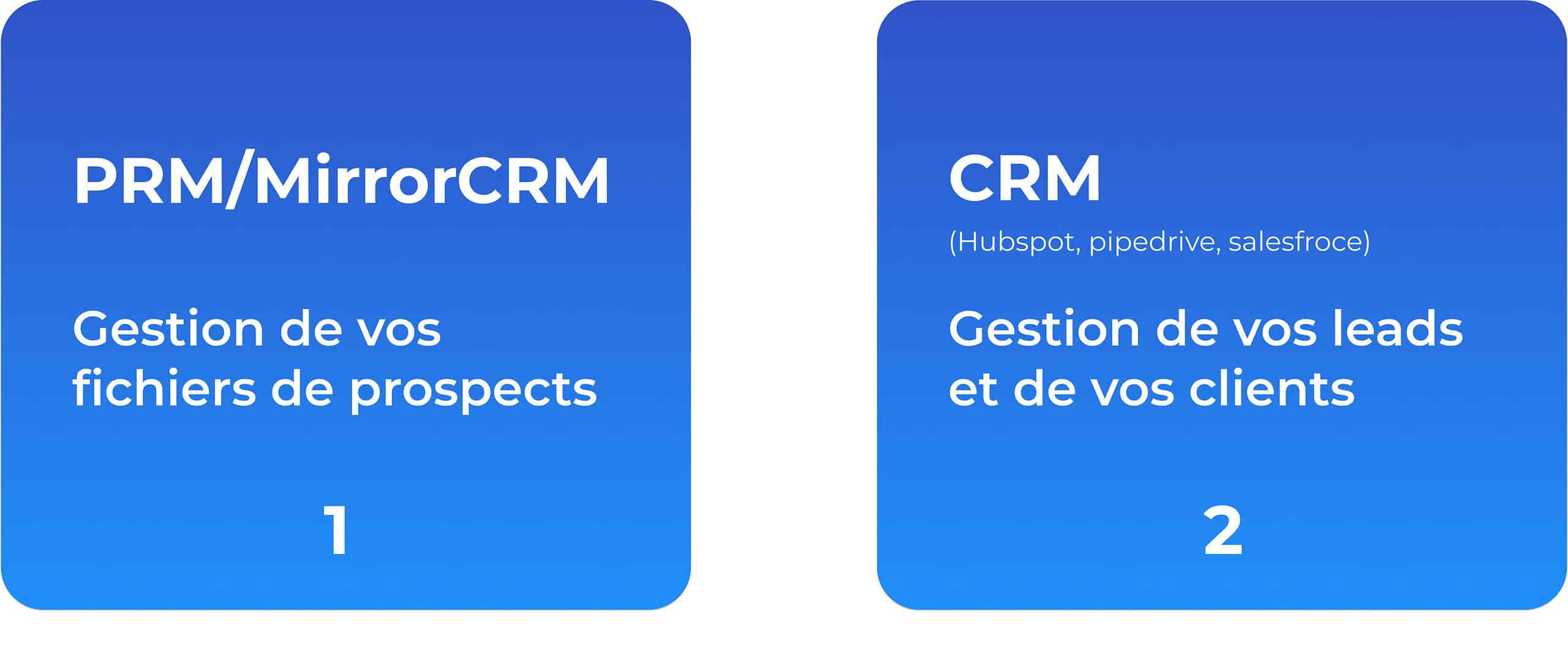
For the rest of this article, keep in mind that a prospect and a lead are not the same thing. A lead is a prospect who has shown an initial interest in your solution or service.
Definition: what is a CRM (Customer Relationship Management)?
A CRM, or customer relationship management system, is an essential piece of software for any company wishing to optimize its interactions with current and future customers. It brings together the technologies used to organize, automate and synchronize every aspect of customer interactions, including marketing, sales and customer service. A CRM is primarily used to improve business relationships, increase customer satisfaction and, as a result, maximize performance and revenue. This is also where most lead nurturing campaigns live.
By centralizing customer data in a single system, a CRM provides a complete, up-to-date view of every customer or lead in the company, making personalized and efficient communication easier. This centralization also helps to anticipate customer needs, manage leads and sales opportunities effectively, and resolve problems quickly thanks to easy access to complete customer information.
Process automation is another key facet of CRM systems. By automating repetitive tasks such as sending marketing campaigns, updating order status and tracking customer interactions, companies can devote more time to value-added activities, while reducing human error and increasing efficiency.
Last but not least, the reporting and analysis tools built into CRM software give companies valuable insights into their performance. These tools can be used to measure and analyze sales trends, marketing campaign effectiveness and customer behavior, providing decision-makers with the information they need to adjust their strategies in line with observed results and objectives.
As we saw in the diagram above, a CRM should not be concerned with prospecting files and raw prospects. It was designed solely for leads and customers. For a well-structured and efficient customer acquisition system, it is important to distinguish between PRM and CRM.
Why link your CRM to a PRM?
Coupling your customer relationship management (CRM) software with a prospect relationship management (PRM) system, or pre-CRM, can offer many strategic advantages for optimizing your company’s sales management. This combination harmonizes prospecting efforts with existing customer relationship management, creating an effective continuum in the process of converting prospects into loyal customers.
Firstly, a PRM focuses on the early stages of the sales cycle: identifying, qualifying and managing prospects before they become qualified leads. By integrating the PRM with the CRM, companies can ensure a smooth transition of data between marketing and sales teams. This integration enables better coordination and a more strategic use of the information collected during initial contacts with prospects.
Secondly, using a PRM and a CRM together offers a more complete view of the customer journey. While the CRM provides details of interactions with current customers and helps maintain these relationships, the PRM enriches this process by integrating data on preliminary interactions that can be crucial to understanding the needs and expectations of future customers. This extended view helps to personalize offers and target communications more precisely.
Thirdly, coupling the two systems improves the effectiveness of marketing and sales campaigns. With access to a richer, better-structured database, teams can segment markets more finely, adjust their messages based on previous feedback, and optimize conversion strategies. This leads to a more judicious use of resources and a potential increase in the conversion rate from prospects to customers.
In short, integrating a PRM with a traditional CRM enhances a company’s ability to manage its sales funnel in a more integrated and efficient way, from lead generation to customer retention, supporting a better ROI and sustained growth.
What to look for in a PRM alongside your automation tools
A PRM, or pre-CRM, is designed to manage initial interactions with prospects effectively. Connected to your existing prospecting tools, it centralizes and compiles your data to automate the creation of essential tasks, boosting sales teams’ productivity. This automation not only increases the number of leads generated each month, but also improves your company’s sales velocity.
The usefulness of a CRM to centralize customer acquisition efforts is well established. However, managing inbound and outbound campaigns together can be tricky without a clear separation between the two. A PRM focuses on managing outbound prospecting campaigns, optimizing follow-ups and accelerating the pace of sales interactions, while the traditional CRM concentrates on marketing and communication actions. Think of it as the control tower of your lead acquisition phase. Once a prospect has reached a sufficient level of maturity, they are converted into a lead and handed over to your classic CRM.
A good PRM offers a structured approach to converting prospects into qualified leads. The efficiency of your sales pipeline is at the heart of its added value, enabling rigorous sales follow-up to improve your company’s overall performance.
In practice, a PRM should simplify your prospecting processes on four points:
- Optimized sales velocity: a continuous flow of targeted sales actions, reducing information overload and dispersion of effort.
- Increased efficiency: automatic tasks that free up time for your sales reps, enabling them to concentrate on prospecting.
- Data centralization: data from various tools consolidated into a single interface, providing a clear, up-to-date view of your sales pipeline.
- Efficient synchronization: features like webhooks, so that the tool adapts easily to your prospecting campaigns, organizing and managing your pipeline more efficiently.
Ultimately, a PRM is a practical solution for companies aiming to tangibly improve their prospecting efficiency. By simplifying operations and boosting productivity, it gives you a real advantage for efficiently turning prospects into leads.
Combining a CRM with a PRM represents a major step forward for companies. It enables them not only to accurately track where each prospect is in the conversion journey, but also to ensure that every interaction is optimized to drive conversion. With the right tools, companies have a clear overview and an integrated strategy to turn the effectiveness of early interactions into tangible business success. It is a winning LinkedIn prospecting strategy that offers seamless follow-up from prospect to loyal customer, boosting your company’s overall performance.