


SaaS (Software as a Service) solutions have become an essential part of corporate IT, thanks to their cloud-based delivery model. So what is a SaaS solution, and why do so many companies rely on one? The SaaS approach eliminates the need for cumbersome on-site installations and maintenance, allowing companies to significantly reduce their infrastructure costs. By adopting SaaS software, companies benefit from continuous, automatic updates, guaranteeing constant access to the latest features without manual intervention. For example, our MirrorProfiles platform takes the technical preparation and upkeep of your prospecting accounts off your plate. Beyond the expertise aspect, bringing everything in-house is also less economical: SaaS solutions benefit from economies of scale thanks to their many customers, something an end-customer company simply cannot replicate.
The flexibility offered by the SaaS model also allows a company to adapt quickly to changing market requirements, while offering the possibility of scaling resources as needed, without the constraints of a physical infrastructure.
What is a SaaS solution?
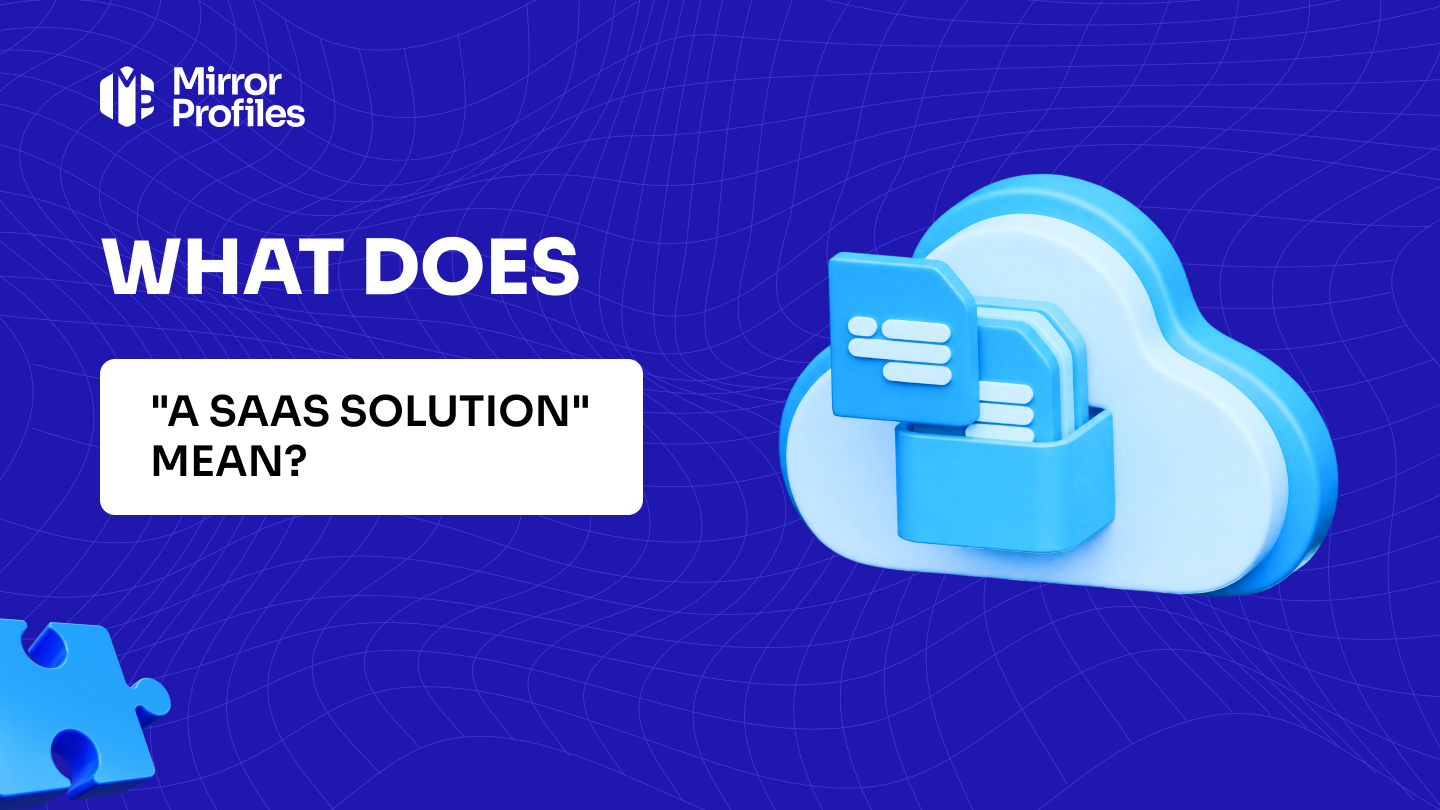
The term “SaaS” stands for “Software as a Service”. This approach to software is distinguished by its method of distribution and use: instead of being installed and managed locally on individual computers or corporate servers, the software is hosted in the cloud by a third-party provider and accessed via the Internet.
SaaS solutions offer many advantages for a company, not least in terms of cost reduction and IT complexity. Business users don’t have to worry about purchasing, installing, updating or maintaining the hardware and software infrastructure needed to run the software. All this is taken care of by the SaaS provider. As a result, businesses can access up-to-date, highly available applications with less upfront investment and lower operating costs. There are plenty of SaaS solutions available when a company wants to automate its lead generation on LinkedIn or any other acquisition channel. You will have to make a choice; our team, made up of growth and sales automation specialists, can help you weigh the options.
The SaaS model also offers remarkable elasticity and adaptability. Companies can easily scale their subscriptions up or down according to their needs, without having to worry about hardware limitations or licensing constraints. This translates into greater operational flexibility and the ability to respond quickly to market developments or organizational needs.
In short, a SaaS solution is an efficient, modern way of consuming software, offering flexibility, scalability and accessibility, which makes it a preferred (and today almost necessary) option for many companies looking to optimize their IT processes while keeping costs under control.
Why use a SaaS solution?
Adopting SaaS solutions offers a series of substantial advantages for businesses of all sizes, but is particularly beneficial for small and medium-sized enterprises (SMEs) looking to maximize their resources while remaining competitive.
- Reduced costs: one of the main reasons for choosing a SaaS solution is to significantly reduce IT costs. Initial costs are considerably lower, as there is no need to invest in servers and other costly infrastructure. What’s more, maintenance and update costs are borne by the provider, allowing companies to convert high fixed costs into more manageable variable costs.
- Rapid deployment: SaaS solutions can be deployed very quickly, unlike traditional software that requires lengthy installation and configuration. This speed of deployment means that companies can benefit immediately from new features and enhancements.
- Automatic updates: the SaaS provider manages all necessary updates and enhancements, ensuring that users always have the latest version of the software without service interruptions or additional costs. Companies no longer need to devote time and resources to system maintenance. Our MirrorProfiles clients may not always see it, but 90% of our time goes into the quality and security of our accounts.
- Accessibility and mobility: with a SaaS solution, users can access applications and data from any location with an Internet connection. This makes remote work and work across devices easier, increasing workplace flexibility and improving employee productivity.
- Enhanced security: SaaS providers invest heavily in security to protect their customers’ data, often at levels of security that SMEs could not afford on their own. Regular backups, disaster recovery and advanced encryption protocols are generally included in the service.
- Scalability: SaaS solutions offer great flexibility in terms of scalability. Companies can easily adjust their subscriptions to add or remove users, features or storage capacity as their needs change, without investing in new infrastructure. With the rental of warmed-up LinkedIn accounts ready for automation, LinkedIn has become a scalable acquisition channel, which it was not before: your volume grows in proportion to the number of accounts.
- Focus on core business: by delegating IT management to an external provider, companies can concentrate more on their core business. This frees up valuable resources that can be reallocated to strategic initiatives rather than technology infrastructure management.
In conclusion, using a SaaS solution offers companies a host of practical and economic advantages, enabling them to optimize operations, reduce risk and focus on growth and innovation.
A concrete example: the pre-CRM as a SaaS solution
Having explored the benefits and definition of SaaS solutions, it is interesting to see how these benefits materialize in a specific application: the pre-CRM, a tool designed for sales prospecting. Delivered as SaaS, a pre-CRM embodies the flexibility, efficiency and scalability that SaaS solutions offer their users.
A pre-CRM synchronizes with your existing prospecting tools, creating a unified ecosystem that centralizes all relevant data in a single place. This data aggregation gives you a clear, real-time view of your sales pipeline, which improves decision-making and strategic planning.
By providing an automated to-do list, it transforms the way sales reps manage their day. They can follow up all their prospects from a single interface, eliminating repetitive tasks and reducing the risk of error. This time saving translates directly into higher sales velocity, allowing teams to concentrate on value-added actions.
Automated reporting ensures that all sales actions are recorded and analyzed. This allows continuous evaluation of the effectiveness of prospecting campaigns, and helps adjust strategies according to observed performance.
A pre-CRM, focused exclusively on prospecting and the early stage of the customer relationship, clearly separates prospecting activities from inbound and outbound marketing campaigns. This separation avoids the confusion and errors that can arise when these functions are mixed together in a single system. By using a pre-CRM for prospecting and a traditional CRM for marketing and communication, companies can optimize their campaigns and maximize their results.
In short, the pre-CRM illustrates how a SaaS solution designed specifically for sales needs can transform prospecting processes by offering an integrated and automated platform. This approach allows companies to maximize sales efficiency while reaping the fundamental benefits of SaaS technologies.
SaaS solutions represent a major step forward for companies looking to modernize their IT infrastructure, reduce costs and increase operational efficiency. These platforms enable agile application management, automatic updates and global access, providing a solid foundation for innovation and growth. A pre-CRM delivered as SaaS builds on these benefits by streamlining sales processes, improving the coordination of prospecting data, and increasing productivity through automated tasks and accurate reporting. This illustrates the transformative impact of SaaS solutions, not only in terms of technology management, but also for the continuous improvement of sales and operational strategies.