


Buying followers on LinkedIn is a practice as old as LinkedIn itself, created in 2002.
If you’ve clicked on this article, we’ll show you how buying LinkedIn followers works and, more importantly, why it’s a bad idea (spoiler alert!).
The real aim of this purchase is to strengthen your presence on LinkedIn and gain greater notoriety.
However, to make it really effective, we’ll show you the only solution that exists: the trick that actually works on LinkedIn.
How to buy LinkedIn connections through a specialized platform?
Buying followers on LinkedIn is a practice that has been around for some time. The idea is to rapidly increase the number of your connections to gain credibility on the network.
However, it’s important to note that this method is often counterproductive, as it doesn’t allow you to target followers according to your business sector.
In other words, gaining followers simply to increase your follower count is not an intelligent strategy for developing your network.
It’s best to develop your network thoughtfully, targeting people who are relevant to your industry.
That said, there are many platforms that offer LinkedIn followers for sale. Most of these platforms claim to offer real, active followers, but it’s important to be wary of these claims.
Often, the followers provided are accounts that are inactive or not run by a real person, which is not at all beneficial for your network.
We’ve selected four of the biggest LinkedIn follower-selling platforms to take a closer look at.
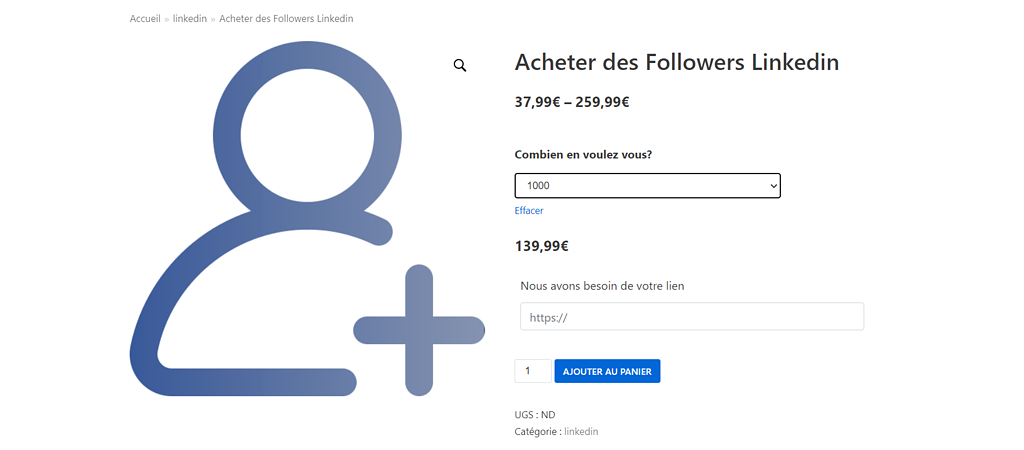
Achatlikes:
This platform claims to offer a superior service by providing only active and verified profiles. They point out that this is particularly important in a world where many popularity-boosting offers are fragile and unconvincing.
Their prices range from a few dozen euros for 200 followers to several hundred for 2,000 (see the screenshot below).
123followers
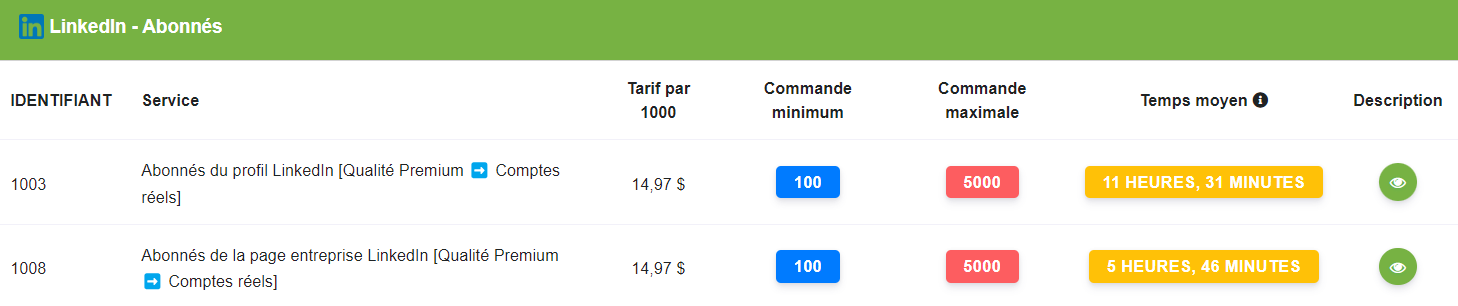
This online platform claims to provide a transparent, high-quality service. They are committed to providing only real LinkedIn followers from real, active accounts.
Their prices start at a few dollars for 100 followers and go up to a few hundred dollars for 20,000.
The Social Media Growth (TSMG):
This company claims to be made up of social media marketing experts who are constantly evolving to incorporate new trends. They indicate that they offer a secure environment with legitimate services.
RiseKarma:
This company says it uses artificial intelligence (AI) to attract new followers. Their AI, RiseKarma AI, takes care of everything, using hundreds of strategies developed over several years.
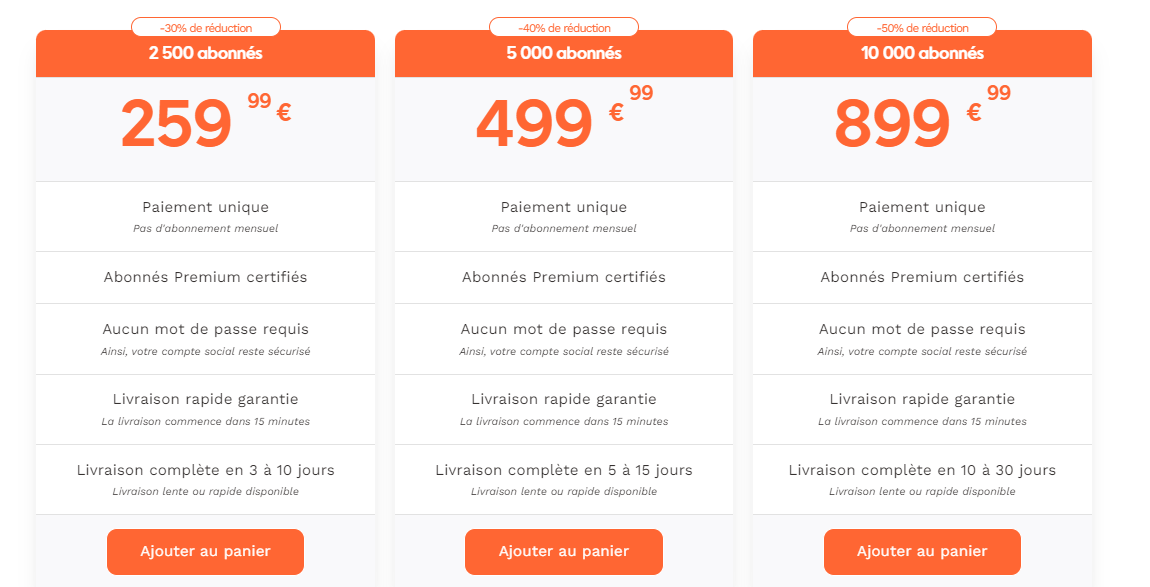
Buying LinkedIn followers is expensive. The notion of price depends on the gain associated with it. In over 5 years of LinkedIn expertise, we’ve never seen an account where buying followers paid off. Worse still, LinkedIn detects these mass acceptances and may restrict your account.
Comparison
In summary, it’s important to consider that while these platforms claim to offer real, active followers, this doesn’t guarantee that they’ll be relevant to your industry. It’s always best to develop your network thoughtfully, targeting people who are relevant to your industry.
As you can see, we at MirrorProfiles aren’t particularly keen on the idea of buying followers on LinkedIn.
And here’s why we think this technique is not only obsolete but also counterproductive:
- Lack of relevance: As mentioned above, purchased followers are often not relevant to your industry. This means that even if your number of followers increases, it won’t have a positive impact on your professional network.
- Risk of restriction: LinkedIn has algorithms in place to detect abnormal increases in follower numbers. If it detects that you are buying followers, your account may be restricted.
- Loss of credibility: If your network discovers that you’ve bought followers, it can damage your professional credibility.
- High cost: Buying followers can be expensive, and as mentioned above, ROI is often low due to the lack of relevance of the followers.
In conclusion, we recommend developing your LinkedIn network by targeting people who are relevant to your industry. It may take longer, but the results will be much more beneficial in the long term.
LinkedIn’s policy and the risks of buying connections
As a platform, LinkedIn encourages authentic, meaningful interaction between its users. The aim is to build a solid, relevant professional network, based on relationships of trust and shared interests. However, buying connections runs counter to this philosophy, and raises a number of issues.
First of all, it’s crucial to understand that LinkedIn expressly prohibits the buying and selling of connections. Engaging in such practices may therefore result in sanctions up to and including restriction or permanent closure of the account. But beyond the direct consequences imposed by the platform, the risks involved in buying connections are manifold.
One of the main dangers lies in the quality of the connections acquired. They are often uncommitted, or even totally inactive, bringing no real added value to your network. What’s more, an artificially inflated network can undermine your professional credibility, as your real contacts may call into question the legitimacy of your profile.
Buying connections can also expose your account to security risks. Providers of this type of service often require access to your account, leaving you vulnerable to malicious practices such as identity theft or the compromise of personal data.
Faced with these risks, it’s imperative to turn to safer, more ethical alternatives for developing your professional network on LinkedIn. This is where a solution like MirrorProfiles comes in: dedicated LinkedIn accounts, manually warmed up over 4 months with more than 500 real connections, from which you send real connection requests to the people you actually want in your network. Your volume is proportional to the number of accounts: each one can send 100 to 120 connection requests a week, so 5 MirrorProfiles accounts mean 500 to 600 requests a week. With a normal acceptance rate, that’s a few hundred new people every week who will see your company’s LinkedIn posts.
Why this technique is obsolete and counterproductive
A LinkedIn account is considered influential when its Social Selling Index (SSI) is above 75.
SSI is a key indicator on LinkedIn, measuring your ability to generate opportunities on the platform. A high SSI indicates a strong influence on the network, and it also allows you to compare yourself with other professionals in your sector and with the members of your network.
SSI is calculated according to four main criteria:
- developing your professional image
- identifying relevant contacts
- sharing information
- creating and maintaining quality relationships
These criteria are essential to maximize your effectiveness on LinkedIn.
Why is a high SSI important?
LinkedIn is an ideal platform for creating and nurturing professional relationships, which can open the door to a wide range of opportunities, from sales and recruitment to career advancement. Although initially designed for sales professionals, SSI is in fact a useful tool for everyone. It allows you to assess your credibility and the impact of your communication on the platform.
A high SSI is generally the result of a strong personal presence and quality interactions. The higher your score, the more likely you are to generate new opportunities.
The limits of buying followers
Buying followers may seem like a shortcut to increasing your SSI, but it’s actually a short-sighted strategy.
Three of the four SSI criteria are directly linked to your professional activity, and no follower-selling platform allows you to buy followers specific to your sector.
By artificially inflating the fourth criterion, you risk compromising the other three in the long term.
What’s more, the number of followers is not a reliable indicator of the credibility or effectiveness of your account. We have observed accounts with 600 connections generating more leads than accounts with 2,000 connections, simply because the network of the 600-connection account was 90% composed of its target.
In short, it’s best to have a LinkedIn account with fewer connections but a high proportion of relevant followers.
LinkedIn will reward this consistency and showcase your content not only to your network, but also to your network’s connections. The advantage therefore lies in both inbound and outbound marketing strategies.
Avoid the pitfalls of unscrupulous connection providers
All players on professional platforms like LinkedIn are looking to make authentic, meaningful connections. However, the reality is often quite different, and the black market in buying connections thrives in the shadow of good practice. To navigate safely and effectively on LinkedIn, it’s crucial to know how to identify and avoid the traps set by unscrupulous connection providers.
1. Promises too good to be true: Beware of offers that promise hundreds or thousands of connections in record time for a derisory price. These offers are often the sign of an unreliable service that doesn’t care whether your LinkedIn account ends up restricted. Let’s face it, going from 500 connections to 2,000 in a week is impossible in practice, unless by some miracle you make a huge buzz or get on TV.
2. Lack of transparency: A reliable supplier should be transparent about its methods and expected results. If you encounter any opacity regarding the processes used to expand your network, consider this a red flag.
3. Requests for access to your account: Giving a third party access to your own LinkedIn account exposes your personal data to security risks. Any service requiring your login details should be avoided at all costs.
4. Reviews and testimonials: Search for reviews and testimonials about the supplier. Negative experiences from other users are often a good indicator of potential problems. However, you should also be careful about the authenticity of positive reviews, as they may be fictitious.
5. Quantity rather than quality: A good supplier should focus on the quality of connections rather than their quantity. Relevant, engaged connections will add far more value to your professional network than thousands of passive or irrelevant connections. That’s why the accounts we rent come with “only” 500 or so connections, but every one of them is a real connection, made during four months of manual warm-up.
The key to building a solid, reliable professional network on LinkedIn lies in authenticity and meaningful interaction (comments, likes…). Tools and services that respect this philosophy, such as MirrorProfiles, offer a sustainable and ethical alternative to buying connections, helping you to establish quality connections based on shared interests and professional goals.
The only way to boost your presence on LinkedIn
A presence on LinkedIn is crucial to establishing your professional credibility, expanding your network, accessing new opportunities and reinforcing your personal or corporate brand. It encompasses several elements, including a complete profile, regular and engaging activity, a diverse network and positive interactions with others on the platform.
Improve your LinkedIn profile
To maximize your potential on LinkedIn, it’s essential to have an optimized profile. This includes a professional profile photo, a catchy headline, a detailed summary, a complete list of your skills and experience, recommendations, etc. Profile optimization: an optimized LinkedIn profile is your digital business card. Make sure it accurately reflects your professional experience, skills and aspirations. A complete and engaging profile naturally attracts more relevant connections.
MirrorProfiles offers several tutorials created in collaboration with LinkedIn expert Ruben Taieb. These guides cover different aspects of optimizing your profile and will take you step by step through the different sections of your profile, giving you invaluable advice on how to optimize them.
Genuine, relevant engagement is the cornerstone of a solid professional network. Participate actively: this means commenting, sharing and publishing content that brings value to your industry. This naturally attracts like-minded professionals, fostering meaningful connections.
The benefits of account verticalization
Account verticalization, i.e. specializing your profile and content for a specific sector, can also increase your visibility and influence on LinkedIn. Verticalization consists of carrying out connection request campaigns on a specific target only. Instead of adding connections en masse, identify professionals who share common interests or operate in similar fields. Use LinkedIn’s advanced search tools to find individuals who really match your ideal profile.
This can not only increase engagement on your publications, but also make your prospecting campaigns more effective.
By targeting a specific sector, you can reach not only your direct connections (1st) but also the connections of your connections (1st of your 1st), and so on. Give and ask for recommendations and skill endorsements. This strengthens your credibility and that of your network, encouraging new, high-quality connections to approach you.
Use of automation and targeting tools
Finally, using automation tools can also help to increase your presence on LinkedIn. These tools can automate certain tasks, such as sending invitations to connect or messages, which can save you time and allow you to concentrate on other aspects of your LinkedIn strategy.
However, it is important to use them with caution and not to automate all your interactions on the platform.
What’s more, it’s essential to target your audience correctly on LinkedIn. You can do this by using LinkedIn’s advanced search filters to find professionals who match your target demographic and profession.
In summary, to boost your presence on LinkedIn, it’s essential to have a complete and optimized profile, to be active and engaging on the platform, to target your audience correctly and to use automation tools with care.
By following these steps, you can increase your visibility and influence on LinkedIn, which can lead to new opportunities and a strengthening of your personal or corporate brand.
Conclusion
In conclusion, while buying followers on LinkedIn may seem like a quick and easy way to increase your visibility and influence on the platform, it’s actually a short-term strategy that can have negative long-term consequences.
Not only can this compromise your SSI and therefore your credibility on the platform, but it can also lead to a loss of trust on the part of your network and, in the worst case, a restriction of your account by LinkedIn.
The only viable solution to really increase your presence on LinkedIn is to adopt a more strategic and thoughtful approach.
This includes optimizing your profile, increasing your activity and engagement on the platform, building a network of relevant, quality connections, and careful use of automation and targeting tools.
MirrorProfiles is a useful resource if you want to move fast without giving up on quality: dedicated accounts with real connections, and a prospecting volume that scales with the number of accounts. It’s a good compromise between quantity and quality.
Ultimately, the quality of your network and engagement on LinkedIn is far more important than the quantity of your followers.
By adopting a more strategic approach and using the resources and tools available intelligently, you can create a strong and influential presence on LinkedIn that will help you achieve your professional goals and strengthen your personal or corporate brand.
FAQ – Frequently asked questions
Can you buy LinkedIn followers?
Yes, you can buy them via platforms such as SocialWick or Media Mister. But I don’t recommend it, because you can’t choose which type of followers, which nationality or how often. This means that if you have an American account, you could end up with a sudden jump of 500 Asian connections who have nothing to do with your sector. So it’s no use to you, and worse, it could alert LinkedIn’s detection system and get your account restricted. So you have to be very careful if you want to do it anyway, and go slowly. That said, it’s still a method that all the experts, including MirrorProfiles, advise against. For example, we never use this technique to warm up a LinkedIn account.
How do you buy LinkedIn followers?
You can buy them on SocialWick, for example. Simply select the number of followers, enter your LinkedIn URL and pay. You’ll then gradually receive LinkedIn connection requests that you can accept. Although we don’t recommend this technique, if you do it anyway, remember to decline some of the invitations rather than accepting everything at once.
Do many people still buy LinkedIn followers?
As far as we know, not many. It’s a technique that worked well in 2017 because LinkedIn couldn’t detect it. But since then, LinkedIn has made giant strides in detecting this kind of method, and it has become very risky to resort to it. If you want to build credibility for your business, today it’s better to rent dedicated MirrorProfiles accounts and run your own prospecting campaigns from them: your professional reach grows in proportion to the number of accounts.
Is a bigger network always better?
No, because LinkedIn’s strength is based on first-level relationships. If your network only includes people of interest to your business, then LinkedIn will know you better, and will push you and them to find good profiles. It’s important to maintain a credible network in order to unlock 2nd / 3rd level connections that you can then prospect.